Showing posts with label Gene Therapy. Show all posts

Friday, January 20, 2023

Nanotechnology may improve gene therapy for blindness

Using nanotechnology that enabled mRNA-based COVID-19 vaccines, a new approach to gene therapy may improve how physicians treat inherited forms of blindness.

Tuesday, May 25, 2021

A new type of Gene Therapy demonstrates the potential to treat Blindness

(c) Veronique Juvin, Sciartwork

Doctors have been able to use a form of gene therapy described as optogenetics for the first time to restore partial vision in a blind person. The research team genetically altered retinal ganglion cells to become light-sensitive in a man whose vision was destroyed by retinitis pigmentosa, a genetic disorder that breaks down cells that absorb and convert light into brain signals.

Wednesday, October 21, 2020

Study reveals significant restoration of retinal and visual function following Gene Therapy

(c) Nature Biomedical Engg
A breakthrough study, led by researchers from the University of California, Irvine, has demonstrated restoration of retinal and visual functions of mice models suffering from inherited retinal disease.

Published today in Nature Biomedical Engineering, the paper, titled, “Restoration of visual function in adult mice with an inherited retinal disease via adenine base editing,” illustrates the use of a new generation CRISPR technology and lays the foundation for the development of a new therapeutic modality for a wide range of inherited ocular diseases caused by different gene mutations.

Monday, September 14, 2020

New OCT technique offers better potential in retinal stem cell and gene therapy treatment


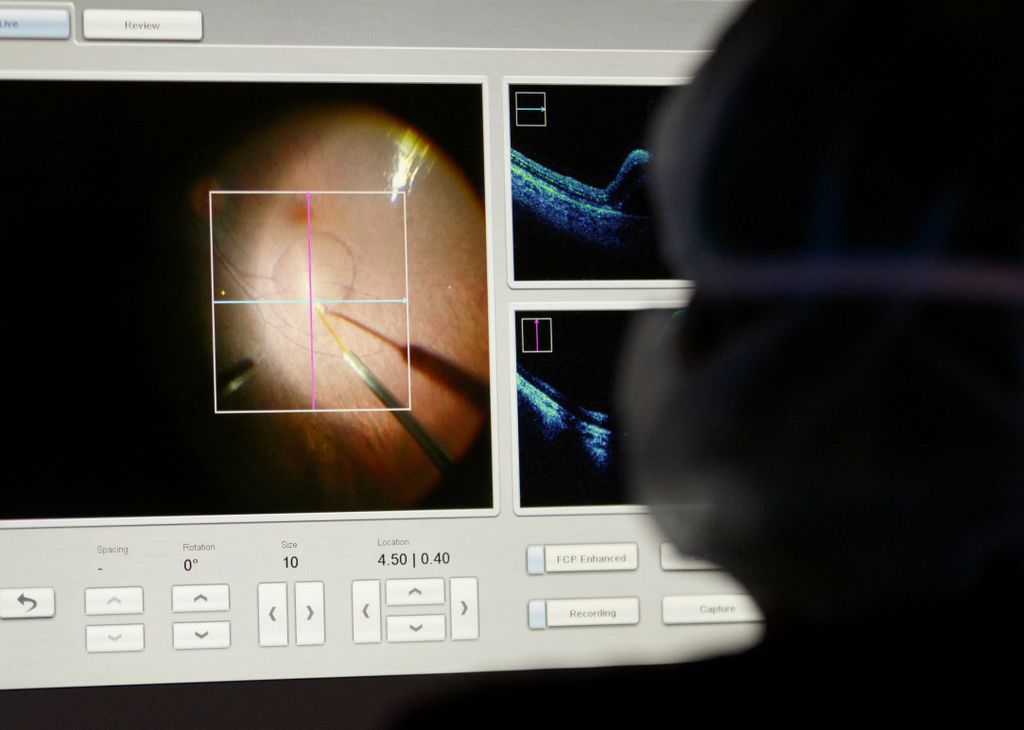
Researchers at the University of Washington have modified the standard process of OCT (optical coherence tomography) to detect minute changes in response to light in individual photoreceptors in the living eye. The technique has potential in the testing of therapies such as stem cells or gene therapy to treat retinal disease.

Tuesday, December 18, 2018

Injection Improves Vision in a Form of Childhood Blindness

(c) NIH
A new treatment for patients with a form of congenital retinal blindness has shown success in improving vision, according to results published today in Nature Medicine led by researchers at the Scheie Eye Institute  in the Perelman School of Medicine at the University of Pennsylvania.

Sunday, March 25, 2018

LCA patients gain benefit from Spark Therapeutics' gene therapy treatment, Luxturna

(c) Mass Eye & Ear
With the approval of Spark Therapeutics' Luxturna for Leber's Congenital Amaurosis (LCA), eye institutions around the US have started offering the treatment to their patients. In recent days, we have heard of this treatment being offered for the first time after the approval in Massachusetts Eye and Ear in Boston, followed the same day by the Children's Hospital of Los Angeles. A few days later, Bascom Palmer Eye Institute completed its first case.

Tuesday, March 6, 2018

New Research demonstrates success with Gene Therapy for a form of Inherited Macular Degeneration

(c) UPenn News
Researchers from the University of Pennsylvania have developed a gene therapy that successfully treats a form of macular degeneration in a canine model. The work sets the stage for translating the findings into a human therapy for an inherited disease that results in a progressive loss of central vision and which is currently untreatable.

Monday, October 9, 2017

FDA to soon decide approval for Spark Therapeutics' gene therapy for Leber Congenital Amaurosis

In the next few days, FDA panel will consider whether to advice approval for gene therapy for Leber's Congenital Amaurosis (LCA), which has been extensively tested in clinical trials by Spark Therapeutics.

Gene therapy shows promise for reversing blindness

In a laboratory study in Oxford, researchers have shown how it might be possible to reverse blindness using gene therapy to reprogram cells at the back of the eye to become light sensitive.

Monday, October 5, 2015

Ocular treatment likely to become first Gene Therapy approved in US

(c) nature.com
Spark Therapeutics has announced positive results from the Phase 3 pivotal trial of its lead gene therapy product candidate, SPK-RPE65, for the treatment of RPE65-mediated inherited retinal dystrophies (IRDs). These results represent the first successful randomized, controlled Phase 3 trial ever completed in gene therapy for a genetic disease.


Monday, August 24, 2015

RetroSense Therapeutics Gets Approval for Clinical Trials in Retinitis Pigmentosa

(c) nature.com
RetroSense Therapeutics’ Investigational New Drug (IND) application for gene therapy based clinical trial for their product RST-001 has received clearance from the US Food and Drug Administration. RetroSense is developing RST-001 for the treatment of retinitis pigmentosa, a genetic condition that leads to the progressive degeneration of rod and cone photoreceptors (cells found in the retina that sense light), resulting in severe vision loss and blindness. With its IND now in effect, RetroSense expects to initiate a Phase I/II clinical trial by year-end in order to evaluate the safety and, potentially, efficacy of RST-001.

Wednesday, April 15, 2015

Is the red-green color blindness gene therapy cure ready for humans?

Researchers at the Eye Institute of the University of Washington have successfully used gene therapy to cure color blindness in adult monkeys. In the photo on the left (photo credit), a squirrel monkey, who was treated for red-green color blindness, is seen enjoying a feast of colored fruits and vegetables. The image was digitally altered to simulate what the scene would look like to a person (or monkey) with red-green color blindness. 

Tuesday, October 14, 2014

Harvard and Astellas Pharma collboarate on gene therapy for Retinitis Pigmentosa

Astellas Pharma Inc. has announced a research collaboration with Constance L Cepko, Ph.D., an investigator at Harvard Medical School, Boston, Massachusetts, focused on discovering the pathologic mechanism for retinitis pigmentosa and identification of  new therapeutic targets. Astellas and Harvard will work with the aim to provide a new treatment option with a view of a gene therapy, to retinitis pigmentosa patients who have difficulty maintaining good vision.